Your Local Mortgage Lender
Located in Alpharetta, Georgia
Personalized Mortgage Experience
Shelby Pennix offers personalized service and loan options you'll love. We shop multiple lenders to find the best rate and product for you, getting you into your dream home faster.
With wholesale interest rates and cutting-edge technology, we make the mortgage process seamless. Trust the experts who focus solely on mortgages. Support your local community and experience elite client service.
Let us help you achieve your homeownership dreams
The Home Loan Process
Mortgage Pre-Approval
Get pre-approved from one of our Loan Officers to see how much you can afford.
Review The Process
Work with our team to find your next home you would like to move into
Loan Application
Complete your home loan application to get the lending process started.
Don't take my word for it
Mortgage Programs
Experience the best mortgage experience located in Alpharetta, Georgia
Home Loan Options
Our experienced mortgage advisors will walk you through the best mortgage loan program that will fit your specific scenario.
Conventional Home Loans.
FHA Home Loans.
Non-QM
VA Home Loans.
Frequently Asked Questions
How often can I refinance my mortgage?
There is no limit to the number of times you can refinance. However, you must qualify every time you apply and there will be costs associated with closing the loan each time.
Can I buy a home if I do not have money for a down payment?
Yes! There are a number of bond programs that offer low or no down payment financing options.
How do I know which mortgage is right for me?
The key to choosing the right mortgage is to understand the range of options and features available to you, as well as your budget, circumstances, and goals. Our licensed mortgage professionals are here to help you navigate that process. The more you know, the more comfortable and confident you will be choosing the best option for you and your family.
How long will the loan process take?
The Truth in Lending Act (TILA) does not permit a lender to close a loan until at least seven (7) business days have passed from the date your application was received. A typical home loan takes 30 days, as a number of third-party services such as appraisals, title work, and credit are required in conjunction with the mortgage process. Once you familiarize your Loan Officer with the details of your specific loan scenario, they will be able to provide you with a more specific timeline.
Will I qualify for a home loan?
The only way to find out is to speak with a qualified mortgage professional. Our Loan Officers have helped numerous clients who didn’t know if they could qualify to become home owners. We take the time to understand your financial situation and long-term financial goals, and then match you with the loan program that best fits your needs. Your approval for a loan may also largely depend on the price of the home you are financing. Getting pre-qualified prior to beginning your home search can give you an idea of what you may be able to afford.
Why do people refinance their mortgages?
Homeowners typically refinance to save money, either by obtaining a lower interest rate or by reducing the term of their loan. Refinancing is also a way to convert an adjustable loan to a fixed loan or to consolidate debts.
How much money will I have to pay upfront to buy a home?
This question does not have a simple, one-size-fits-all answer. The exact amount will depend on the price of the home you buy as well the type of mortgage financing you choose. Depending on your loan program, your down payment could be as much as 20% of the home’s price or as little as 3%, while some loans require no down payment at all.
Can I get a mortgage after bankruptcy?
You may still qualify for a home loan even if you have experienced a bankruptcy. The best way to find out if you qualify is to talk with a Loan Officer to discuss your options. Be sure to bring all paperwork regarding your bankruptcy so your Loan Officer can find the program that best fits your situation.
Should I lock my interest rate now, or wait until we are closer to our closing?
Interest rates fluctuate all day, every day. If an interest rate is good, it may be in your best interest to lock now. If you wait, you run the risk of an increase in rates later. If you are concerned that rates may go down after you lock, contact your Loan Officer to discuss your options. Some programs allow you to lock for an extended period and choose to lower your rate should a better one become available.
Most Recent Blog Updates
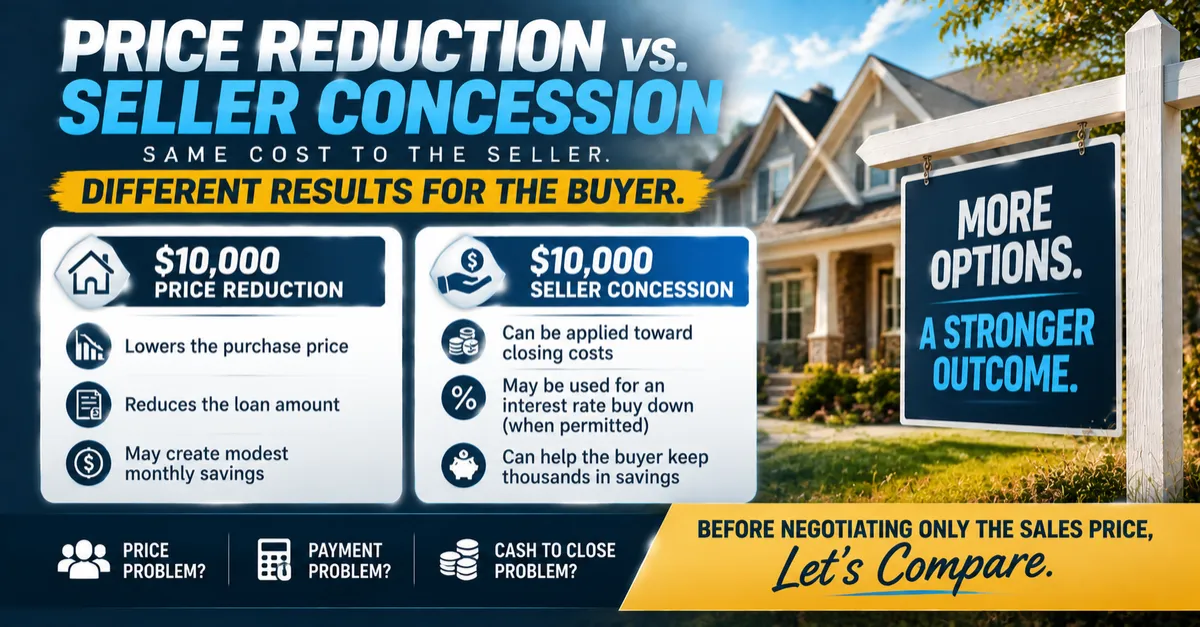
A Price Reduction and a Seller Concession Cost the Same but They Do Not Produce the Same Result
The Negotiating Comparison Most Buyers and Agents Never Run
A ten thousand dollar price reduction and a ten thousand dollar seller concession both cost the seller the same amount at the closing table. What they do for the buyer on the other side of that transaction can be dramatically different and understanding the distinction is what separates a good negotiating strategy from a great one.
What a Price Reduction Actually Produces
When a seller reduces the purchase price by ten thousand dollars the buyer finances a smaller loan. The monthly principal and interest payment decreases but modestly. On a typical thirty-year mortgage a ten thousand dollar reduction in the loan amount produces roughly a sixty to seventy dollar monthly savings depending on the rate. The buyer pays less for the home on paper but the practical monthly impact is limited.
What a Seller Concession Can Accomplish Instead
The same ten thousand dollars structured as a seller concession toward allowable closing costs keeps thousands of dollars in the buyer's bank account at closing. For a buyer who is stretching to cover both the down payment and the closing costs that cash preservation can be the difference between making the purchase work and not making it work at all.
When the concession is applied toward an interest rate buydown rather than closing costs the monthly payment benefit can exceed what the equivalent price reduction would have produced. Buying down the rate with seller-funded dollars creates a lower payment that persists for the life of the loan and depending on the structure of the buydown that monthly savings can be meaningfully larger than the sixty to seventy dollars a price reduction would generate.
Which Option Is Right Depends on the Buyer's Actual Obstacle
As Shelby Pennix explains the right choice is not universal. It depends on where the buyer is feeling the most pressure.
If price is the primary concern and the buyer needs to see a lower purchase number for psychological or appraisal-related reasons a price reduction may be the right tool. If payment is the issue and the buyer can afford the cash to close but needs the monthly obligation to come down the rate buydown funded by seller concessions often produces a better result than the equivalent price reduction. If cash to close is the bottleneck and the buyer is qualified but running tight on liquid funds a closing cost credit keeps money in their pocket where it matters most.
What to Do Before Negotiating Only the Sales Price
Message Shelby Pennix the word COMPARE and she will show you what each option may actually accomplish for your specific situation before a negotiating approach is locked in. Running the comparison before the offer is written produces better outcomes than discovering the more effective structure after the terms are already set.
Reach Shelby Pennix by phone or text at 404-451-1250 or send a DM directly with any questions.
Sources
ConsumerFinancialProtectionBureau.gov
FannieMae.com
MortgageNewsDaily.com
Investopedia.com
BankRate.com

Mortgage Calculator
See your total mortgage payments using the tool below.
| Year | Interest | Principal | Balance |
|---|